In 2025, the Museo del Tessuto Foundation celebrated the Museum’s first 50 years with the exhibition “Silk Treasures. Textile Masterpieces from the Falletti Donation“, curated by Daniela Degl’Innocenti.
The exhibition opened to the public on 20 December 2024 and was originally scheduled to run through 21 December 2025, before being extended to 3 May 2026.

The exhibition marked a significant milestone rooted in the Museum’s origins. Fifty years earlier, the institution had been established following a major donation of antique textiles by textile entrepreneur and collector Loriano Bertini to the Tullio Buzzi Institute of Prato. Half a century later, this anniversary was commemorated with another exceptional contribution: the collection of Florentine physician Giovanni Falletti.
An eclectic collector with wide-ranging intellectual interests, Falletti devoted more than 50 years to researching, preserving, and assembling textile artifacts, embroidery, books, prints, jewelry, historical weapons, and ritual masks from across Europe, Asia, and Africa.

A large panel with textiles from the Museum’s collections flanked by graphic reproductions illustrates the development of the main textile decorative motifs adopted by workshops between the 15th and 18th centuries (horizontally developed symmetrical structure pattern, vertically developed asymmetrical structure pattern, ogival mesh pattern, small ratio pattern, isolated motif pattern, meandering vertical structure pattern).
This most generous donation counts almost 2,000 greatly assorted objects, including artifacts of incredible historical, artistic and anthropological value, such as 250 Japanese prints from the second half of the 18th and 19th centuries by artists such as Hokusai, Hiroshige, Kuniyoshi, Utamaro, textiles from European manufactures from the 15th to the 18th centuries, more than 450 lithographs, etchings, woodcuts and prints from the 16th to the 19th centuries – including Dürer, Van Leyden, Salvator Rosa, Piranesi, Max Klinger, Lorenzo Viani – and more than 1,000 objects including embroidery, ornamental bands, panels, masks, jewelry and ritual weapons from Africa, Central Asia, East Asia and South America.

Silk Treasures. Textile Masterpieces from the Falletti Donation is the first exhibition formed with works from this substantial collection that has extraordinarily enriched the Museum’s heritage.
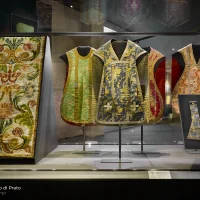
Curated by Daniela Degl’Innocenti, curator of Museo del Tessuto, with the scientific consultancy of Roberta Orsi Landini, Italy’s foremost scholar of textiles and costume, the exhibition presents antique textile and embroidery artefacts for the first time. The selection represents the initial nucleus from which Falletti began his journey as a collector. Falletti’s collection began by pure, lucky chance after he was particularly struck by a 15th-century green velvet cope (liturgical robe) displayed in the window of a Florentine antique dealer.

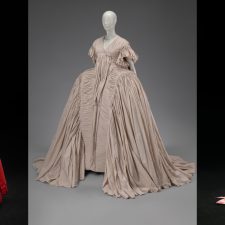
Exhibited in the hall specifically dedicated to historical textiles, the exhibition unfolds along a chronological path that spans four centuries of great textile manufacturing and crosses styles, productions, materials and subjects, exceptional witnesses of European production from the 15th to the end of the 18th century.
These fabrics were used to make sumptuous secular robes for the aristocracies of the time. Thanks to their enormous prestige and value, they were later donated to religious institutions that reused them to make sacred vestments such as chasubles, dalmatics, copes: an extraordinary custom of reuse that allowed the conservation of textile masterpieces, some wonderful examples of which are displayed for the public in the exhibition.

To facilitate an understanding of the historical and technical content, the exhibition hall includes two media tables that use different methods and languages to narrate the fabric-making process and the how the art of silk developed up to the pre-industrial period. Digital microscopes offer a closer look at the internal structure and intricacies of the woven velvet, damask, brocading and lampas (figured silk fabrics). Lastly, graphic reproductions alongside the textiles illustrate the development of the main decorative motifs used by the workshops between the 15th and 18th centuries. Reproductions of important paintings alongside textiles from the same period make the different functions of these precious silk masterpieces immediately apparent.

The exhibition is accompanied by a catalogue published by Edifir with in-depth analyses and fact sheets edited by Daniela Degl’Innocenti and Roberta Orsi Landini.

Statement by Fabia Romagnoli, president of the Museo del Tessuto Foundation
I would like to sincerely thank Giovanni Falletti for this extraordinary donation, which significantly enriches the Museum’s heritage and its contents, allowing it to further broaden its horizons to interdisciplinary themes and amplifying, 50 years later, the great donation by the Museum’s founder Loriano Bertini.
I would like to thank the founding members of the Foundation: the Municipality of Prato, the Chamber of Commerce of Pistoia-Prato and the Province of Prato, and most especially the Municipality for their continued support of the Museum’s initiatives, as well as the cohort of institutional partners such as Fondazione Cassa di Risparmio di Prato, Saperi and Estra. Heartfelt thanks go to the Region of Tuscany for its specific support for the exhibition marking this special occasion.
Lastly, a huge thank you also goes out to the Textile Lovers, the network mainly composed of textile companies in our area that continuously support Museo del Tessuto di Prato.

Statement by Giovanni Falletti, donor
I would like to thank the Museum Director, the Collection Curator, and the President of the Museo del Tessuto Foundation for their kind thanks for my donation, and for the excellent presentation of this exhibition using a significant part of it.
The donation did not end with our discussions about it many months ago. In fact, after this first conversation concerning what I had at that time, everything I later purchased in the areas I find most interesting – after keeping them for myself for a bit – was added to what I had already donated. This will be the case in the future, as long as I am blessed with my time here.
I chose to donate my collections to Museo del Tessuto di Prato for many reasons. I certainly did not want what I have collected to be dispersed into 1,000 inappropriate and unsuited pieces. I have always considered Museo del Tessuto di Prato an optimal institute thanks to its high cultural and scientific level. I have visited some of their exhibitions on several occasions and appreciated the excellent presentation of the materials and the thoroughness of the cultural-historical texts accompanying them. The Museum’s scientific studies were also impeccable. I therefore knew my collection was going into good hands. Moreover, another important factor in my choice was the observation that this Museum, unlike other major institutes, uses its assets for multiple exhibitions and other initiatives, and not only in Prato.
Thus I was sure my donations would not end up buried in noble but inaccessible repositories. Even this exhibition – from how it was presented to me by the Museum managers, who are much younger than me and can therefore more successfully channel their physical and intellectual energy – has been set up beautifully and I hope, indeed I am sure, that it will be successful, making all their efforts worthwhile.
Hence this donation, which I would consider “in progress,” has been mutually beneficial. Finally, the donation to a Museum allows my things to no longer be for the pleasure of an individual, but to become of public use.

The First 50 Years of Museo del Tessuto
The birth and formation of Museo del Tessuto di Prato, the most representative cultural institution in Prato’s textile district, is strongly linked to the Tullio Buzzi Institute and the Alumni Association.
After a study trip to France in the late 1940s, Prof. Giuseppe Ponzecchi’s had matured the idea of creating a collection of various types of antique textiles in order to facilitate teaching textile design and technique to students. Subsequently, thanks to the efforts of Giuseppe’s son Carlo Ponzecchi and the Alumni Association – which worked with genuine passion to raise awareness of the city’s industrial past and present – the first nuclei of the Museum’s collections were created starting in the 1960s. In 1975 Loriano Bertini, a textile entrepreneur and collector, in an act of great civic sensitivity and stately generosity, donated a collection of 612 antique textiles to the Buzzi Institute, which he had acquired from the well-known Florentine antiquarian Giuseppe Salvadori. This important donation gave the impetus to create a full-fledged museum, formally opened on the school premises on 20 December 1975.

The Museum’s development has been punctuated by significant milestones and events since then: the move to the temporary exhibition venue at the municipal palace, the creation of the Museo del Tessuto Association to manage activities, the creation of a Contemporary Section to collect the fashion trends of Prato Expo, the inauguration of the final home at the former Campolmi factory in 2003, the concomitant creation of the Museo del Tessuto Foundation by the Prato Chamber of Commerce (now the Pistoia-Prato Chamber of Commerce), Municipality of Prato, Province of Prato and Prato Industrial Union (now Confindustria Toscana Nord).
More than 400,000 people have passed through the Museum’s doors at the Campolmi factory over the past two decades, and the collections have steadily grown – more than 11,000 objects from 2003 to 2023 – thanks to donations received from the Association of Friends of Museo del Tessuto, alumni, individuals and businesses, accompanied by a few targeted purchases. Thanks to the trust of donors and the initial founding donation of Loriano Bertini, the Museum now boasts a rare, internationally significant collection that includes antique textiles from every continent, costumes, clothing and fashion accessories spanning from ancient times to the 21st century, tools and machinery, textile samples and many other categories of artefacts and historical evidence.

The archive of fashion trends presented at Prato Expo in 2015 was joined in 2021 by the Textile Library: an archive of contemporary textiles organised by thematic units which now counts more than 1,500 physical and digitised samples, aimed at developing educational activities and consultancy and training services.
Furthermore, the Museum’s education section has greatly gown over time and plays an increasingly strategic role: each year it designs and delivers an increasingly comprehensive programme of activities for schools of all levels (counting nearly 20,000 students between 2021 and 2024), for children and their families, for audiences with special needs and for foreign nationals, improving the accessibility of the museum’s heritage and strengthening inclusion year after year.

Numerous temporary exhibitions have been held over the past two decades, representing an important opportunity for scientific research and dialogue. These exhibitions are fundamentally important in attracting a non-specialist audience and enhancing the Museum of the City of Prato as an active cultural centre at local, regional and national levels.
The main exhibitions from 2003 to date include those devoted to fashion, such as Jeans! (2005), Thayaht, an Artist at the Origins of Made in Italy (2007), Vintage. The Irresistible Charm of Used Garments (2012-13), The White Shirt according to Me. Gianfranco Ferré in collaboration with the Gianfranco Ferré Foundation (2014, exhibited in Milan at Palazzo Reale in 2015 and in Phoenix, Arizona USA in 2016), Across Art and Fashion. Nostalgia for the Future in Post-war Artist Textiles in collaboration with the Ferragamo Foundation (2016), Mr & Mrs Clark. Ossie Clark and Celia Birtwell | Fashion and Prints 1965-74 (2022), later exhibited at Fondazione Sozzani, Milan (2023), Kimono. Reflections of Art between Japan and the West (2023) and Walter Albini, The Talent, The Designer (2024).

To facilitate an understanding of the historical and technical content of the ancient textiles, the exhibition hall includes two media tables that use different methods and languages to narrate the fabric-making process and the how the manufacturing art of silk developed up to the pre-industrial period. This special table has digital microscopes that allow visitors to observe the internal structure of some fabrics (velvet, damask, brocading, lampas) and to consider the intricacies of the weaves that made their creation possible.
The main exhibitions focused on ancient textiles have included Mediterranean Weaving (2006) devoted to the contaminations between Near Eastern and European textile culture in medieval and modern times, The Style of the Tsar in collaboration with the Hermitage Museum in St Petersburg (2009); Caprice and Reason, on textile culture and costume of the 18th century in collaboration with the Costume Gallery/Uffizi and Stibbert Museum (2017-18), Turandot and the Fantastic East of Puccini, Chini and Caramba on the costumes of the world premiere of Puccini’s opera (2021, then at the Accademia Nazionale di Santa Cecilia-Museo degli Strumenti musicali, Auditorium Parco della Musica in Rome in 2022).
The main exhibitions on costume in films have included Marie Antoinette. The Oscar-winning Costumes of a Queen (2018) and Pinocchio in the Costumes of Massimo Cantini Parrini from Matteo Garrone’s film (2019-2020).

Participation in dozens of European projects (with different funding programmes) has enabled the Foundation to strengthen its international relations, consolidate a European reputation and develop projects that would have been difficult to implement without those opportunities. These projects range from the digitisation of its assets to its use as a valuable source of inspiration and training for young designers and companies, from providing activities to support eco-innovative start-ups to testing participatory models for cultural institutions, up to experimenting with the dimension of play for the development of cultural content.
50 years of museum activity in a vital and complex manufacturing and industrial area: an important cultural milestone and a stimulus for the future, where history is not only a branch of knowledge but also a way to understand the world.


Museo del Tessuto Foundation, Prato Presents
SILK TREASURES | TEXTILE MASTERPIECES FROM THE FALLETTI DONATION
curated by Daniela Degl’Innocenti.
Extended to 3 May 2026
Prato, Museo del Tessuto
Via Puccetti 3, Prato
www.museodeltessuto.it | @museodeltessuto
Visiting hours:
Tuesday through Thursday: 10 am to 3 pm
Friday and Saturday: 10 am to 7 pm
Sunday: 3 pm to 7 pm
Monday closed
Museo del Tessuto
www.museodeltessuto.it | @museodeltessuto
The Museo del Tessuto is the largest cultural centre in Italy dedicated to the promotion of historical and contemporary textile production and art. The Museum represents the historical memory and the cultural interface of the Prato district, which has been identified with textile production since the Middle Ages. Today the district boasts over 7,000 companies operating in this sector.
All images courtesy of the Museo del Tessuto.
Tags: apparel, artisan, artisanal, clothing, collectors, craftsmanship, culture, Daniela Degl'Innocenti, design, designer spotlight, designers, dresses, embroidery, Fabia Romagnoli, fabric patterns, fashion, fashion and lifestyle, fashion design, fashion designers, floral motif, flower motifs, French, Giovanni Falletti, Loriano Bertini, Luxury, luxury fashion, motifs, Museo del Tessuto Foundation, pattern, Prato Textile Museum, style, textile artifacts, textile entrepreneur, textiles, Top, traditional textiles, Tullio Buzzi Institute of Prato
Share this page