From 25 October 2025 to 3 May 2026
- The Museum pays tribute to two iconic figures in French fashion with an exhibition designed by Olivier Saillard.
- 50 masterpieces from the Azzedine Alaïa Foundation in Paris along with original drawings and sketches by Balenciaga, all on display thanks to a collaboration with Balenciaga Archives in Paris.
The Museo del Tessuto Foundation concludes its 50th anniversary exhibition calendar with a major exhibition dedicated to two absolute icons of French fashion; Azzedine ALAÏA and Cristóbal BALENCIAGA.
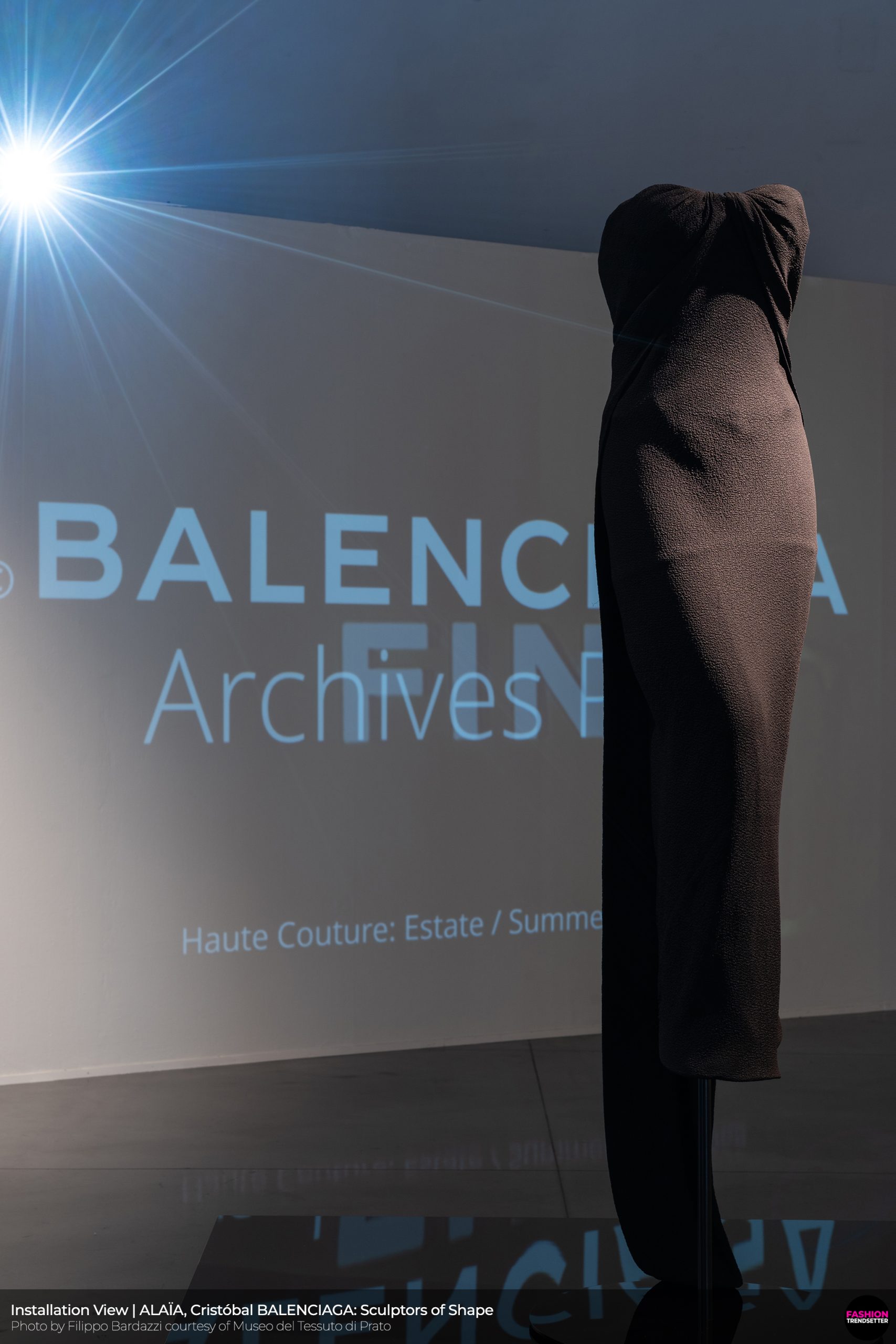
Created in collaboration with the Azzedine Alaïa Foundation in Paris chaired by Carla Sozzani, the exhibition Azzedine Alaïa and Cristóbal Balenciaga. Sculptors of Shape is curated by Olivier Saillard and counts the French Embassy in Italy among its patrons, as well as the extraordinary participation of Balenciaga Archives in Paris, for an exceptional exhibition project coming to Italy for the first time.
The concept for the exhibition dates back to the Azzedine Alaïa Foundation in 2020, at the behest of Hubert de Givenchy. A few months after the passing of Azzedine Alaïa (Tunis 1935 – Paris 2017) and decades after that of Balenciaga (Getaria 1895 – Jávea 1972), as a great admirer of Balenciaga and a key figure in classical fashion, Givenchy shared his wish with the Alaïa Foundation to bring these two great talents together, both skilled experimenters with shapes and volumes that have profoundly marked the history of fashion.

The display in the Prato Textile Museum was specifically designed for the exhibition spaces of the former Campolmi factory, with a layout by Guicciardini & Magni Architetti in collaboration with Arianna Sarti, museum exhibition manager.
Twenty-five creations by Azzedine Alaïa – considered one of the last couturiers, capable of mastering every stage in a garment’s creation, from design to tailoring – dialogue with as many garments by Cristóbal Balenciaga, in a timeless comparison.
Alongside the garments, the Textile Museum is exhibiting 12 original drawings by Balenciaga dated between 1950 and 1968 from Balenciaga Archives in Paris, shown in Italy for the very first time. The drawings, some of which include technical notes for tailoring and fabric samples, are accompanied by an equal number of original photos of the garments being worn, valuable and extraordinary records of the Spanish designer’s creative process.

Alaïa and Balenciaga are united by key elements of continuity: the art of couture, meticulous tailoring and the enhancement of the feminine form. Both designers share humble beginnings – Balenciaga in Spain, Alaïa in Tunisia – learning the art of sewing within their families, and later achieving success with an influential Parisian clientele.
Fabric is the common creative medium, but while Balenciaga shaped his architecture with wools, satins, and silks, such as the innovative “gazar” he invented in 1958, Alaïa transformed knitted fabric until it became a hallmark of his art, using leather to sculpt and shape bodies. Balenciaga preferred to close his atelier rather than convert to ready-to-wear, and Alaïa put an end to the incessant chasing of collections, independently choosing the most opportune times to present his work.

As Azzedine recounts, when Maison Balenciaga closed for good in 1968, as a young up-and-coming designer, he was called upon by Mademoiselle Renée – the Maison’s historic deputy general manager – to choose a selection of Master Balenciaga’s creations, because only his hands would be able to rework and renew them without betraying them. The young Alaïa was so amazed by the shapes, the architecture of the cuts and the technical skill of each garment that he marked this encounter with Balenciaga’s work as the starting point for his own, and personally collected his most representative garments.

Both couturiers were passionate about sartorial construction and known for their perfectionism and ability to cut and sew with their own hands. Balenciaga’s research resulted in perfect formal elegance, while Alaïa’s highlighted precise sensuality. Balenciaga was a great innovator of forms and creator of wearable architecture, while Alaia wrapped and sculpted the body as if it were a second skin.

The exhibition is completed by a film on the life and work of Azzedine Alaïa made by Joe McKenna, fashion editor and stylist, and a never-before-seen video featuring the presentations of Balenciaga’s Haute Couture Summer 1960 and 1968 collections from Balenciaga Archives in Paris.
With this exhibition falling during its 50th anniversary, the Prato Textile Museum continues its work studying and appreciating the history of 20th-century fashion and its protagonists, addressing the theme of French couture with a tribute to Cristóbal Balenciaga and Azzedine Alaïa. The exhibition comes after those dedicated to the great Italian masters Gianfranco Ferrè (2014) and Walter Albini, the father of Italian prêt-à-porter (2024), and English creators such as Ossie Clark and Celia Birtwell (2022), protagonists of the London scene of the 1960s and 1970s.

The Display Itinerary
The exhibition opens with two iconic pieces, symbolizing Alaïa and Balenciaga’s two interpretations of femininity. Alongside these pieces, 12 original drawings by Balenciaga and videos from the Balenciaga Archives and Joe McKenna are displayed.
Continuing, the large exhibition hall houses the garments in three sections: “Atelier Tailleur,” “Atelier Flou,” and “Spagna.” In the tradition of French haute couture tailoring, there are two distinct departments: the Atelier Tailleur and the Atelier Flou. The former creates more structured garments, such as coats, tailored jackets, cape/dress suits, and frock coats, using rigorous tailoring techniques similar to those of menswear; the latter creates more fluid and soft garments, such as blouses, skirts, and dresses. It’s the realm of lightness, where delicate silk fabrics such as chiffon, mousseline, and organza are favored for evening wear, or wool crepe and fine knits for daytime.
The final section is dedicated to Spain. Flamenco, boleros, and lace are the recurring themes that conclude the exhibition, a true tribute to traditional Spanish clothing and the materials of the Mediterranean textile tradition.

The Textile Museum has edited the Italian edition of the exhibition catalogue, which will be available at the bookshop and the shop online: https://shop.museodeltessuto.it/it/
The exhibition was created with the support of:
Municipality of Prato, Cassa di Risparmio di Prato Foundation, Saperi, Estra; General Directorate of Education, Research and Cultural Institutes of the Ministry of Culture, Tuscany Region, the companies of the Museo del Tessuto Textile Lovers.
Main Contributors: Arché sb, Marini Industrie
Contributors: Balli il Lanificio, Gruppo Colle, Lyria
Other Contributors: Antilotex Flock Italia, Confindustria Toscana Nord, Lineapiù Italia, as well as Banco BPM.
Technical Sponsors: Opera Laboratori, Pointex, Unicoop Firenze
Mobility Partner: Autolinee Toscane
Hospitality Partners: Art Hotel Milano and Art Hotel Museo, Prato


MUSEO DEL TESSUTO PRATO

Museo del Tessuto Foundation, Prato Presents
Azzedine ALAÏA, Cristóbal BALENCIAGA
SCULPTORS OF SHAPE
curated by Olivier Saillard
25 October 2025 – 3 May 2026
Prato, Museo del Tessuto
Via Puccetti 3, Prato
www.museodeltessuto.it | @museodeltessuto
Azzedine ALAÏA – Born in Tunis in 1935. He studied sculpture at the School of Fine Arts in Tunis. At a very young age, he learned to sew with his sister Hafida. In 1956, he moved to Paris where he did an internship at Christian Dior and worked for two seasons at Guy Laroche. In the early 1960s, he began creating clothes for a private clientele, members of Parisian high society, influenced by the timeless elegance of some of his clients, such as Louise de Vilmorin, Arletty, Simone Zehrfuss, Cécile de Rothschild, Greta Garbo and Claudine Colbert. In 1964, he opened his own atelier at 60 Rue de Bellechasse and worked for his private couture clientele. In 1982, he presented his first ready-to-wear collection and in 1983 he founded his own fashion house. Success followed success, and in October 1985 he received two Oscars de la Mode for “Designer of the Year” and “Best French Collection”.
In 1987, Azzedine Alaïa purchased a complex of buildings at 18 Rue de la Verrerie, where he moved his atelier, studio, apartment and boutique. His fashion shows were acclaimed by the international press and the world’s most famous models walked the runway for him. In the mid-1990s, at the height of his fame, he stepped away from the spotlight and chose to devote himself once again to a private couture clientele. He returned to the catwalks in 2003 and enjoyed a second period of glory. In July 2017, he presented his last Haute Couture collection. A few months later, on 18 November, Azzedine Alaïa died in Paris. A worthy heir to the masters of haute couture, Azzedine Alaïa was the last couturier to master all stages of the creation of his designs, from cutting to tailoring. He was also a great collector and amassed over 15,000 extraordinary pieces that bear witness to the history of fashion in the 20th and 21st centuries.
Cristóbal BALENCIAGA – Born in Getaria, Spain, in 1895, the son of a seamstress, Cristóbal Balenciaga learned to sew at a very young age. Showing great talent and promise as an artist, he was soon working alongside his mother under the patronage of her clients from the Spanish nobility.
As a teenager, he earned the distinction of master tailor and moved to Madrid to pursue his craft. Through his expert skills in cutting, draping, and tailoring, he rose to prominence designing for the Spanish royal family. In 1937, Balenciaga established his couture atelier on Avenue George V in Paris, quickly becoming one of the most sought-after couturiers in the world by an elite cadre of women from high society, European royals, and Hollywood stars. Loyal clients went to great lengths to travel to the Balenciaga atelier in Paris to own a coveted custom garment created by the couturier. Revered by his contemporaries Christian Dior, Coco Chanel, Hubert de Givenchy, and Pierre Balmain, Balenciaga was one of the only couturiers of the time with the expert ability to pattern, cut, and tailor his own designs. He was also considered a fashion innovator, introducing silhouettes that were groundbreaking for the time. Balenciaga signatures including the square coat, sack dress, baby doll dress, balloon dress, and peacock tail dress secured his icon status. In 1968, at the height of his fame, Balenciaga chose to retire and shutter his eponymous house, marking the end of an era as the reigning king of Parisian couture.
Museo del Tessuto
www.museodeltessuto.it | @museodeltessuto
The Museo del Tessuto is the largest cultural centre in Italy dedicated to the promotion of historical and contemporary textile production and art. The Museum represents the historical memory and the cultural interface of the Prato district, which has been identified with textile production since the Middle Ages. Today the district boasts over 7,000 companies operating in this sector.
All images courtesy of the Museo del Tessuto.
Tags: Alaïa, apparel, artisan, artisanal, Azzedine ALAÏA, Azzedine Alaïa Foundation, BALENCIAGA, clothing, craftsmanship, Cristóbal Balenciaga, culture, design, designer spotlight, designers, dresses, fashion, fashion and lifestyle, fashion design, fashion designers, French, French fashion, Luxury, luxury fashion, Museo del Tessuto Foundation, Olivier Saillard, Prato Textile Museum, style, Top
Share this page